


Introduction
Your player, in a completely ordinary move and without any contact, lands from a jump and collapses to the ground with a cry of pain. The doctor’s diagnosis: an ACL tear. This injury, which seems sudden and a matter of bad luck, is in fact the result of thousands of small incorrect movements accumulated over weeks and months. The question that troubles every coach and doctor is: *“Could we have predicted this?”* The answer, quite surprisingly, is: *“Yes.”*
Traditional data such as GPS and heart rate provide us with valuable information, but they overlook a vital piece of the puzzle.
The Major Limitation of GPS: Quantity vs. Quality
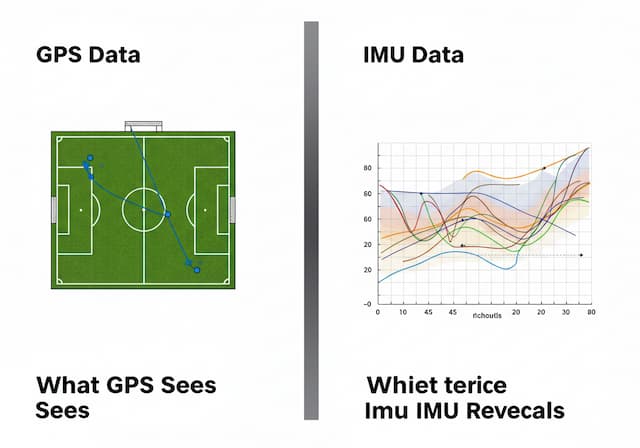
GPS data tells us how far a player has run, at what speed, and what their heatmap on the field looks like. In other words, we measure the *quantity* of movement very well. But GPS is blind to the *quality* of movement. It cannot distinguish between an explosive and efficient sprint start versus a weak and unbalanced one. GPS doesn’t recognize whether your player lands symmetrically on both feet or places more stress on one side. These biomechanical details are the very hidden clues that eventually lead to injury.
Enter IMU: The Microscope for Your Movements
This is where the Inertial Measurement Unit, or IMU, comes into play. This small yet powerful sensor, located at the core of the LiveVest Node, is composed of highly sensitive accelerometers and gyroscopes. With a very high frequency (over 125 times per second), the IMU records even the most subtle movements, accelerations, rotations, and impacts exerted on the player’s body.
If GPS is a roadmap, IMU is an ultra–high-definition slow-motion camera in 8K, capturing every single step of your player.
3 Key Clues IMU Provides for Injury Prevention
IMU data provides the coaching and medical staff with an ocean of insights. Here are three of the most important ones:
1. Detecting Movement Asymmetry (Asymmetry)
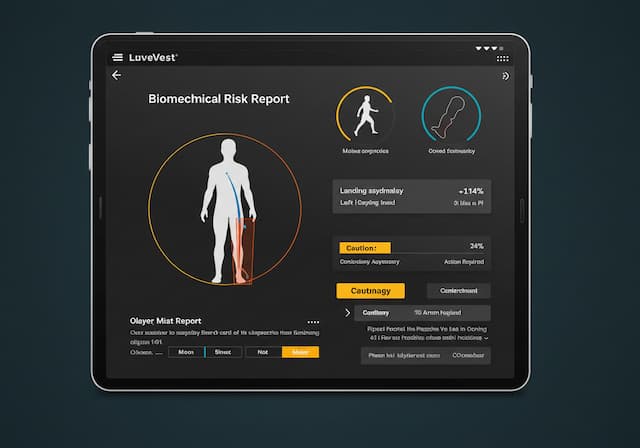
Asymmetry means a player unconsciously relies more on one side of the body than the other when performing a movement, such as jumping or changing direction—for example, consistently landing more forcefully on the left foot. This uneven load is a major risk factor for knee and ankle injuries. The LiveVest system automatically identifies these asymmetries in its reports and alerts you. A warning like *“15% asymmetry in left-foot landing”* can notify you in time to apply corrective training before it’s too late.
2. Measuring True Explosive Efforts
Do two sprints at the same speed place the same stress on the body? Not necessarily. IMU allows us to measure the *G-forces* and acceleration profile of every explosive movement. This means you can distinguish between a smooth sprint and one that is high-load, full of sudden braking forces. These insights are essential for more precise management of speed and power training loads.
3. Detecting Fatigue Through Movement Quality
When a player becomes fatigued, their running form and movement patterns start to break down. Their speed might still look high, but the *quality* of movement has dropped: steps become heavier, and landings or changes of direction lose stability. The IMU detects these subtle shifts in movement patterns. By monitoring declines in movement quality toward the end of a match or training session, you can substitute the player or reduce their training load before fatigue exposes them to a much higher risk of injury.
Conclusion: Focus on Movement Quality, Not Just Quantity
The future of sports science and injury prevention lies in analyzing the *quality* of movements. Relying solely on GPS data is like driving while staring only at the speedometer and ignoring the engine warning lights. With the precise IMU data in the LiveVest system, you can see these biomechanical warning signals and take action before a crisis occurs.

