


Introduction
Your player goes up for a jump—a movement they’ve performed thousands of times. But this time, on the landing, their knee twists badly. The cry of pain cuts through the silence of the stadium. The doctor’s diagnosis: an ACL tear. The season is over. This bitter scenario is one of the greatest fears of any sports team. Everyone calls it “bad luck.” But is it really? Was there truly no way to see this disaster before it happened?
Modern sports science answers with a “maybe.” Many of these non-contact injuries—those occurring without another player’s involvement—develop “silently” and gradually within the athlete’s body. They are the end result of subtle irregularities that our eyes cannot detect. But technology can.
What is IMU? A Microscope for Your Body’s Movements
At the heart of the LiveVest system, alongside the ECG sensor, lies another small yet powerful brain called the Inertial Measurement Unit (IMU). It is composed of an accelerometer, a gyroscope, and a magnetometer. Simply put, an IMU is like the sensor in your phone that rotates the screen when you tilt it—but thousands of times more precise and faster. In LiveVest, the IMU sensor records the athlete’s movements at a frequency of 125 Hz (125 times per second) and enables us to perform biomechanical analysis of the body.
Asymmetry Detection: The First Alarm Bell
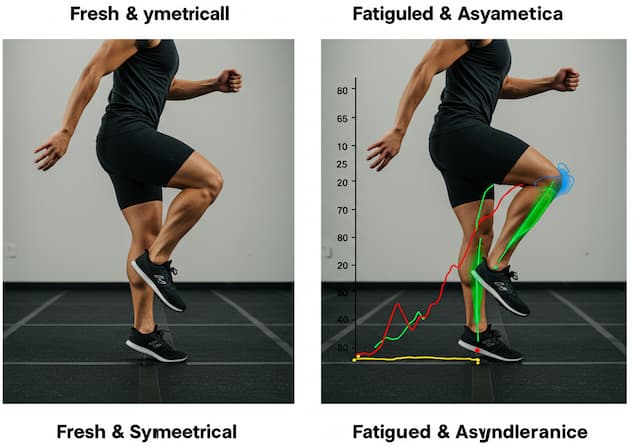
The human body is not perfectly symmetrical by nature, but significant asymmetry between the left and right legs—in metrics such as jump power, ground contact time while running, or impact absorption during landing—is one of the strongest predictors of injury. An athlete may unconsciously place greater load on one leg due to an old injury or muscular weakness. By analyzing IMU data, LiveVest can display this asymmetry as a clear percentage and alert you before this faulty pattern leads to injury.
Neuromuscular Fatigue Measurement
Sometimes a player feels mentally fresh and even their heart rate data (internal load) looks normal, yet their neuromuscular system is fatigued. This fatigue reveals itself in movement patterns: ground contact time becomes longer, jump height decreases, and landing stability is reduced. These are subtle changes that may go unnoticed by the eye, but the IMU records them with precision. This data tells you when the player’s nervous system is “tired” and that high-risk, explosive training should be avoided on that day.
Case Study: Return-to-Play Protocol
One of the most stressful decisions for the medical staff is allowing a key player to return after an injury. The player may say, “I feel fine,” and manual tests may also look positive. But is he truly ready to withstand the demands of competition?
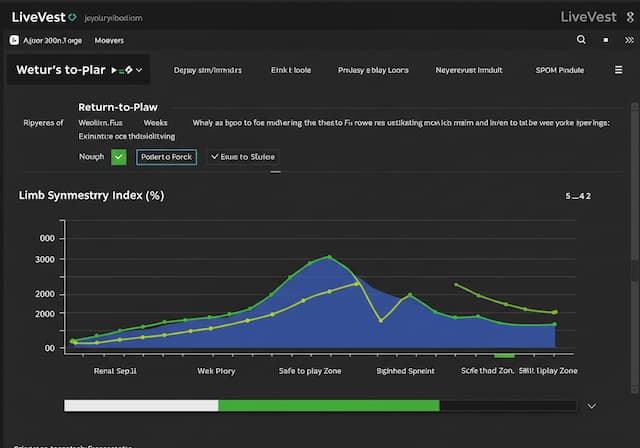
Here, the IMU acts as an impartial judge. By comparing the player’s current biomechanical data (such as symmetry in jumping and running) with their baseline data before the injury, you can obtain an objective, data-driven answer. Only when the Limb Symmetry Index (LSI) returns to a safe level (for example, above 90%) can you confidently give the green light, minimizing the risk of reinjury.
Conclusion: From Reaction to Prevention
Non-contact injuries are the silent enemies of your team’s success. When we rely solely on the eye, we are always “reacting” to these injuries. But by adding a microscopic layer of insight through IMU motion analysis, we can change our strategy. We can identify high-risk patterns before they turn into disasters and protect our athletes’ health with targeted corrective training. This means moving from a reactive approach to a preventive strategy. Intelligent Prevention.
Do you want to see how biomechanical data can help you build a healthier, more resilient team? Ask our experts to demonstrate the motion analysis capabilities of LiveVest in a specialized demo.

