


Introduction
Imagine you’re in the middle of an intense training session. You check the live data of your players and notice that your key striker’s heart rate appears unusually low during an explosive sprint. Is he underperforming? Or is the technology simply feeding you incorrect information? This scenario—caused by relying on common wearable gadgets—can easily lead to misguided judgments and wrong decisions.
Many coaches ask: *“When my smartwatch already shows heart rate, why should I consider a professional system?”* The answer lies in one critical technical difference—the line that separates the world of estimated data from the world of precise data. Let’s explore these two worlds.
Two Technologies, Two Very Different Stories: PPG vs. ECG
Behind every number you see as “heart rate,” there is a technology measuring it. Understanding these technologies is the key to choosing the right tool.
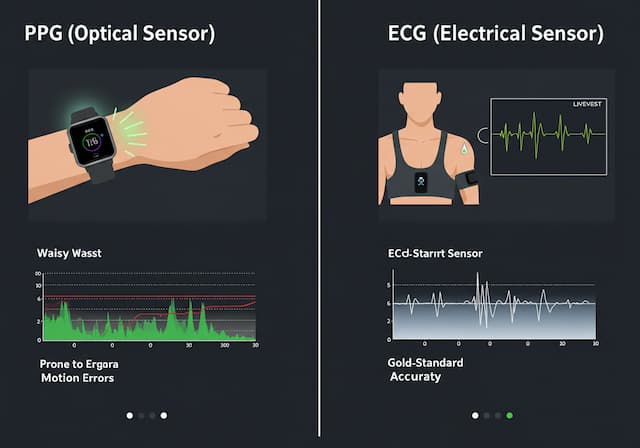
Optical Sensor (PPG): The Magic of Green Light
Almost all smartwatches and fitness bands use a technology called *photoplethysmography* or PPG. This is the very same green light blinking on the underside of your watch.
How Does It Work? These optical sensors shine light onto your skin and measure how much of it is reflected back by the blood flow. With each heartbeat, the volume of blood in the wrist’s vessels changes, and by analyzing these variations, the sensor **estimates the heart rate**. Estimates.
Why Does It Fail in Professional Sports? This method offers acceptable accuracy at rest, but during intense exercise—especially in sports like football with sudden movements, fast sprints, and heavy vibrations—it suffers from *motion artifacts*. Sweating, skin tone, and even how tightly the watch strap is fastened further reduce its reliability. Put simply, relying on PPG is like trying to count cars on a highway while standing on a shaky bridge—the chances of error are extremely high.
Electrocardiogram (ECG): Listening Directly to the Heart
Professional systems like LiveVest use the very same technology applied in hospitals and specialized cardiology clinics: **ECG**.
How does it work? Instead of looking at the blood flow in the wrist, the ECG sensors placed on the chest directly detect the electrical signals …produced by the heart itself. These signals are the primary and most direct source of cardiac activity.
Why Is It the Gold Standard? Because this method is not affected by body movements, it delivers an accurate, real‑time picture of heart activity. It’s like listening directly to a car’s engine instead of guessing the RPM from the vibrations of the chassis. This level of precision is vital for split‑second decision‑making in professional sports.
Beyond Heart Rate: The Magic of Heart Rate Variability (HRV)
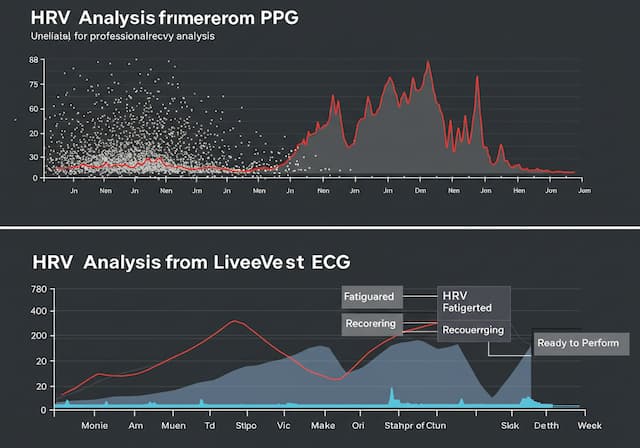
The key difference isn’t just about an accurate heart rate number. One major advantage of ECG is its ability to precisely measure Heart Rate Variability (HRV). is Heart Rate Variability (HRV).
HRV measures the tiny variations in the time interval between consecutive heartbeats (the R‑R interval). Think of your nervous system as a race car—HRV tells you whether that car is fully tuned and ready to race (good recovery) or whether it needs maintenance and rest (accumulated fatigue). This metric is one of the most powerful indicators for assessing an athlete’s stress levels, recovery state, and overall readiness to perform.
To calculate HRV accurately, you need millisecond‑level measurement of the R‑R intervals. PPG sensors, because of their estimated nature and inherent signal delay, perform poorly in delivering reliable HRV data—especially during and right after exercise. In contrast, ECG provides this information with medical‑grade precision, allowing you to assess your players’ true recovery status with confidence.
Final Takeaway: A Comparison at a Glance
| Feature | Optical Sensor (PPG) – Smartwatch | Electrical Sensor (ECG) – LiveVest |
|---|---|---|
| Measurement Method | Estimation from blood flow (optical) | Recording of heart’s electrical signal (direct) |
| Sensor location | Wrist/Arm | Chest (near the heart) |
| Accuracy in Intense Exercise | ❌ Low (prone to motion artifacts) | ✅ Very High (medical gold standard) |
| تحلیل دقیق HRV | ❌ بسیار محدود و غیرقابل استناد | ✅ دقیق و قابل استناد |
| Suggested application | Daily and light activity monitoring | Professional sports, research, and sports medicine |
Estimation or Certainty? The choice is yours.
In the end, choosing between PPG and ECG is choosing between estimation and certainty. For everyday use, an estimate of heart rate is sufficient. But when your decisions affect the health, progress, and professional future of an athlete, there is no room left for guesswork. You need data you can rely on with complete confidence.
Do you want to see the difference in accuracy with your own eyes? Contact us to experience a live demo where we will show you a practical comparison of LiveVest data with common gadgets.

